How do Bookies Set Odds?
Bookmakers have been around for centuries and have perfected the process of providing odds. Odds are a bookmaker's way of predicting the likelihood of a specific outcome and express as a ratio. A bookmaker, for example, may offer odds of 3:1 for a team winning a match. This means that if the team wins, the customer will receive one unit for every three units bet.
Bookmakers calculate the odds for every event using several methods. A common approach is to analyse the H2H. Bookmakers understand how likely an outcome is by looking at the results of similar events in the past. In addition, bookmakers use expert opinions and statistical analysis to determine accurate odds.
Bookmakers rely on the odds they provide to generate a profit, so they must be cautious with the odds they provide. Bookmakers frequently adjust their odds to maximize profits. This means they may offer more generous odds on some events while offering less generous odds on others.
Bookmakers also provide a variety of bets, including moneyline bets, spread bets, and accumulator bets. Moneyline is the most basic type of wager, in which the bettor simply predicts which team will win the event. Spread bets predict the margin of victory, whereas accumulator bets predict the outcome of multiple fixtures.
Bookmakers will use many methods to set the odds. This includes
By doing so, bookmakers ensure they provide the best odds and maximize profits.
Bookmakers play a crucial role in sports betting, allowing bettors to profit based on the outcome of many events. Bookmakers make it easier for bettors to make informed decisions by providing accurate odds and lots of different bets. Understanding how bookmakers give odds is critical for winning big, whether you're a casual bettor or a professional gambler.
Types of Odds
Odds are a crucial component of sports betting and gambling, and there are three types of odds. Fractional, decimal, and American odds are among them.
In a ratio format, fractional odds represent the potential return on a bet to the stake.
In a decimal format, decimal odds represent the potential return on a bet, including the stake.
American odds are a system of odds used by sportsbooks in the United States that indicate the return on a $100 bet. Understanding the various types of odds is critical to becoming an informed and successful bettor.
Decimal Odds
Decimal odds are a popular betting format that betting sites use worldwide. They are simple to understand and are preferred by more experienced gamblers. The total payout of the bet, including the original stake, is expressed as a single number in decimal odds.
For example, if you bet $10 on a decimal odds of 3.00, you would receive $30 in total, including your initial $10 stake. Odds in a decimal format are convenient for calculating potential returns and are crucial for live betting.
They are also widely used in spread betting, where the stake size isn’t fixed. Decimal odds are an excellent way for bettors of all skill levels to get the most out of their betting experience.
Fractional Odds
Fractional odds are a popular betting system used by many punters, especially in the UK and Ireland. These odds are calculated by dividing the amount bet by the amount won, with the result in a fractional format. For example, if a bettor placed a £10 bet and won £20, the fractional odds are 1/2.
Experienced bettors frequently prefer fractional odds because they can easily calculate the potential return on their bet. For example, horse racing punters use fractional odds on their wagers. These bettors can see how much money they will win from their bet by using fractional odds, and they can decide if the risk is worth the reward.
American Odds
American odds, also known as moneyline odds, are a type of betting odds popular with bettors in the United States and Canada.
American odds represent the return the bettor receives for the amount wagered. Odds express either a positive or negative format. A positive line represents the amount won for every $100 wagered, and a negative line is the amount wagered to win $100.
For example, if a punter bets $100 on a team with +200 American odds and the team wins, the bettor will win $200. Similarly, if a bettor bets $100 on a team with -200 American odds and the team wins, the bettor will win $50.
American odds are popular among bettors of all skill levels, from novice to expert. Many sportsbooks provide American odds, making it simple for bettors to find the best lines and place informed bets.
Conversions
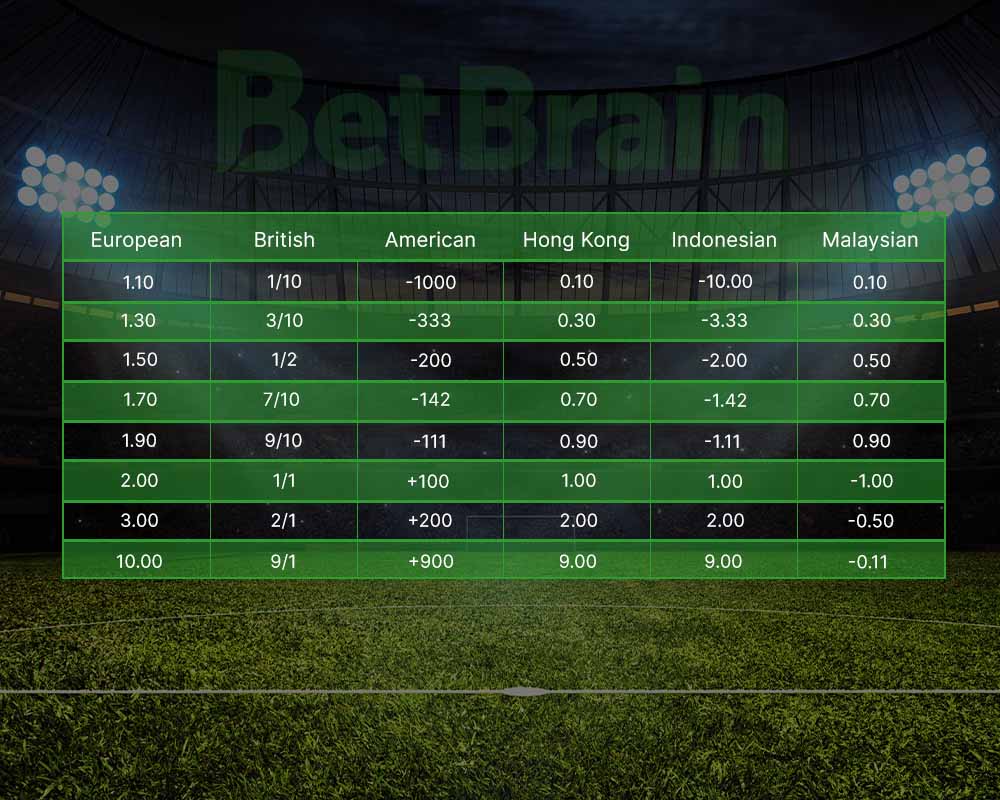
Because bookmakers use different formats, odds conversion is a vital tool for bettors to understand. Knowing how to convert odds from American, fractional, or decimal formats allows bettors to compare the odds provided by many bookmakers. Here's an example of converting American, fractional, and decimal odds:
Decimal | Fractional | American |
3.00 | 2/1 | +200 |
4.00 | 3/1 | +300 |
1.25 | 1/4 | -400 |
A "+" indicates a positive number in American odds, which shows the odds are in favour of the bettor. A "-" denotes a negative number, which means that the odds favour the bookmaker.
For example, when the American odds are +200, the fractional odds are 2/1, and the decimal odds are 3.00. If the American odds are -400, the fractional odds are ¼, and the decimal odds are 1.25.
By converting American, fractional, and decimal odds, you make informed decisions about which betting options to choose. Last but not least, don't hesitate to check out BetBrain's Betting Academy in case you'd like to find all the information a punter would need for a successful session.